
About NomosLogic
Born from Necessity
NomosLogic was built because the infrastructure for truly individualized medicine does not yet exist.
For too long, healthcare has relied on population averages: average risks, average responses, average treatment pathways. That model has produced important advances, but it has also left something essential behind the individual person standing in front of the clinician.
NomosLogic exists to help close that gap.
We are building clinical decision support infrastructure for a future in which care is more individualized, more explainable, and more biologically grounded. A future in which genomics is not treated as a novelty or an isolated test, but as part of the operational fabric of care.

The Story Behind the Company
Matt Hardy
Founder & CEO, NomosLogic Inc., Salt Lake City, Utah
NomosLogic did not begin as a business idea. It began as a personal reckoning.
For years, I lived with symptoms that never fully resolved into a coherent explanation: fatigue, brain fog, chronic pain, gastrointestinal issues, metabolic dysfunction, and a long history of fragmented care. I moved through a system built in silos, with different specialists, different tests, different prescriptions, but no unifying view of the whole person.
Then I ran my own laboratory data alongside a consumer DNA file that had been sitting unused for years.
What came back was clinically meaningful pharmacogenomic risk, actionable safety findings, and interacting genomic factors that helped explain patterns standard care had never connected. Not theoretical signals. Not vague predispositions. Real findings with real implications for treatment and safety.
That moment was the architectural origin of NomosLogic.
It made one fact impossible to ignore: some of the most important signals in healthcare are already present in the data we have. The systems needed to interpret, connect, and act on them in a clinically meaningful way are still missing. Until they are built, individual patients keep paying the cost of a system that is failing them not for lack of information but for lack of architecture.
Patient MH-001
This company began with my own case.
In my own genome, I found clinically significant risks that had never been surfaced through standard care. I found pharmacogenomic findings that could have had serious consequences if the wrong medications had been prescribed. I found interacting genomic architecture tied to gastrointestinal risk, iron dysregulation, metabolic vulnerability, and medication response.
Most importantly, I found that none of it had been meaningfully integrated into care. It should not take building your own platform to discover what matters in your own genome.
That is why NomosLogic exists.
Not because my story is unique, but because it is not. Too many people are still treated as though they are interchangeable with the average patient. Too many clinically relevant signals remain buried across records, reports, and raw genomic data, with no architecture in place to read them as a coherent picture of the person they belong to.
NomosLogic is the architecture.
Why We Built NomosLogic
To make clinically relevant complexity visible.
We are creating infrastructure that connects genomic information, clinical context, pharmacogenomics, laboratory data, and decision logic in a way that is fast, explainable, and operationally useful. Our goal is not to replace clinicians. It is to support clinician decision-making with better context, better pattern recognition, and better individualized insight.
We believe the future of medicine requires systems that are:
Individualized, not merely population-averaged
Explainable, not black-box
Workflow-aware, not detached from care reality
Clinically serious, not consumer-tech theater
Traceable and deterministic where safety matters
Built for real use, not just theoretical promise
Why It Exists
The intersection of biology and architecture.
I am Matt Hardy. Founder and CEO of NomosLogic, sole architect of the platform, and primary inventor on a 16-pillar patent portfolio in clinical genomics and molecular medicine.
My background is biology, software architecture, and the kind of long-horizon technical design that produces foundational infrastructure rather than applications on top of someone else's foundation. I started in biology and pre-med and spent over three decades building software and infrastructure systems before founding NomosLogic.
The conclusion that drove the work was structural. Healthcare does not have a data problem. It has an architectural one. Modern medicine has been reading biology as a list of parts that act independently when biology is actually a constraint network where variants interact with each other, with ancestry, with environmental context, and with the larger system that holds all of it together. Reading parts in isolation is what produces $30 billion a year in adverse drug reactions, the misclassification of evolutionary adaptations as disease, and the population-averaging error that has been failing individual patients for thirty years.
I founded NomosLogic to build the structural fix in production. The platform reads molecular architecture rather than averaging across cohorts that do not represent the patient. Five proprietary engines on one sovereign substrate, in production today, serving seven downstream verticals. Every clinical assertion is rule-based, reproducible, and cryptographically anchored to the rule version that produced it. The deterministic standard for clinical decision infrastructure was not something I was looking for in the field. It did not exist. So I built it.
The science underneath the work is published. The principle of deterministic convergence is the foundational reference work in my second book. The clinical and evolutionary application is the central thesis of my first book, The Adaptation Paradox. Both validate the architectural argument that biology has hidden order and that reading the order changes what counts as a clinical decision for the person in front of the doctor.
The category I am building did not exist before this work. The platform is the proof. The principle is the foundation. The mission is to close the gap between what biology actually knows and what the patient sitting in front of a clinician actually receives, for everyone, not just for those who can pay for personalized care out of pocket.
That is the intersection of biology and architecture, in production.
The Books
Two foundational works behind NomosLogic.
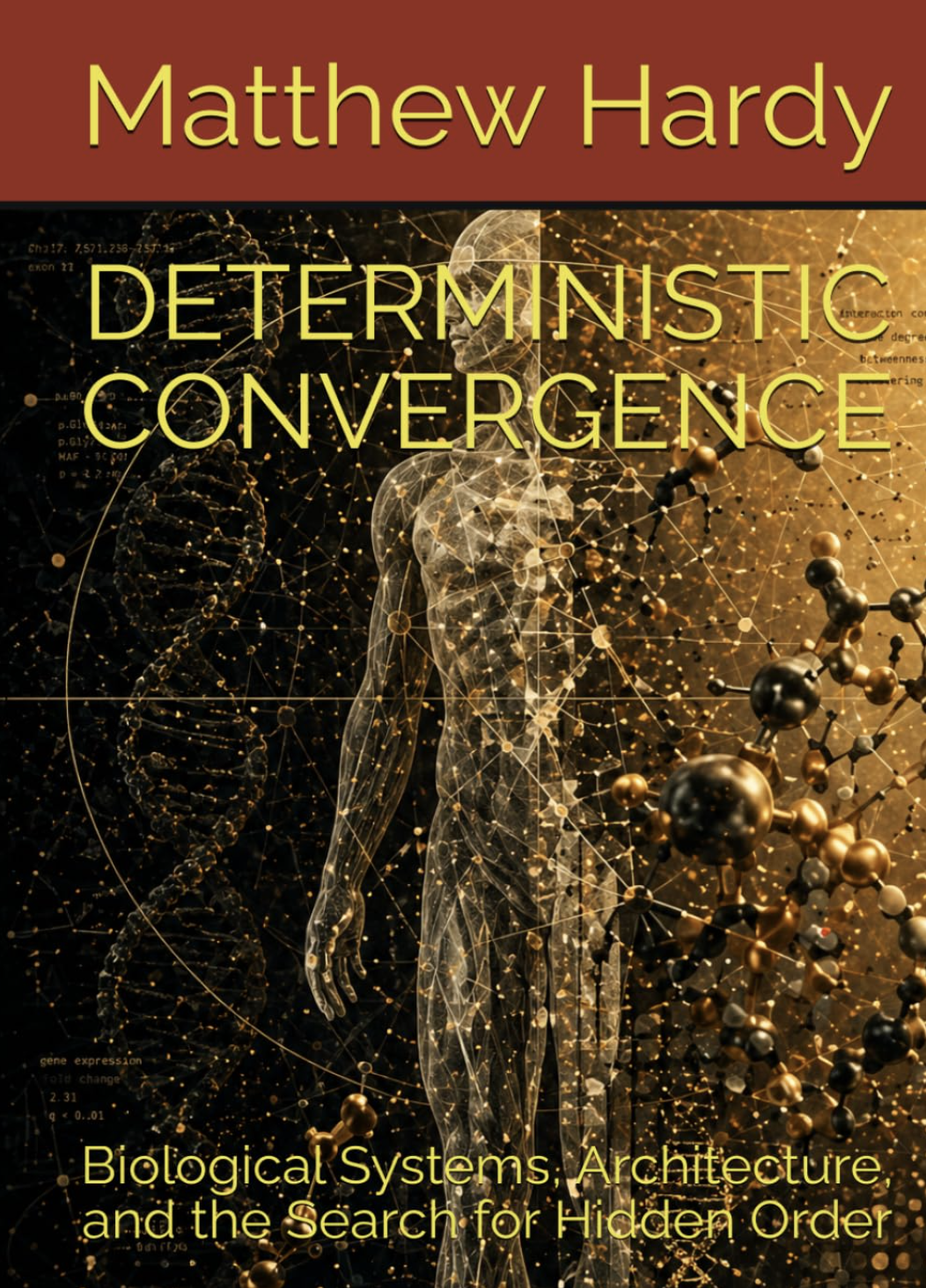
Deterministic Convergence
Biological Systems, Architecture, and the Search for Hidden Order
Matthew Hardy
Biology does not work the way modern genomics reads it. For more than three decades, genomics has been organized around the assumption that disease, drug response, and trait expression can be explained by identifying the variants involved. The result has been an immense catalog of associations and a clinical reality in which the same variants often produce different outcomes in different people. Deterministic Convergence argues that gap is not incidental. It is structural.
The book introduces deterministic convergence and distributed constraint architecture, two operationalized concepts that reframe genomic interpretation from fragment-centered analysis to architecture-centered analysis. Across six clinical domains, cardiovascular, neurological, oncological, renal, metabolic, and hematological, biological systems repeatedly reveal structured behavior that prevailing methods can describe only in parts. A list of parts is not a description of the system that holds the parts together. Biology becomes more intelligible at the level of architecture.
Available on Amazon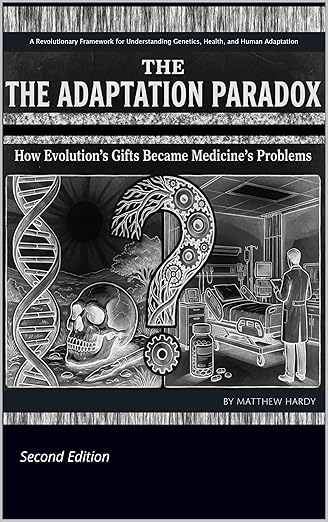
The Adaptation Paradox
How Evolution's Gifts Became Medicine's Problems
Second Edition, Matt Hardy
The intellectual foundation behind NomosLogic. The Adaptation Paradox explores why many modern health conditions are not simple genetic defects but evolutionary adaptations mismatched to contemporary environments. Traits that once conferred survival advantages such as efficient fat storage, heightened immune responses, and altered metabolic pathways can become liabilities when the environment changes faster than biology can follow.
This framework directly informs how NomosLogic interprets genomic architecture: not as a catalog of risk variants, but as a record of evolutionary selection pressure that shapes drug response, disease susceptibility, and system resilience in ways that population-average medicine was never designed to see.
Available on AmazonWhat We Believe
Our work is guided by a few core beliefs.
The individual matters more than the average.
Population-scale research matters, but care happens one person at a time.
Genomics should function as infrastructure.
Genomic information should not sit idle in raw files or disconnected reports. It should be translated into clinically relevant insight that can support real decisions.
Clinical systems must remain explainable.
In healthcare, opacity is not sophistication. When the stakes are high, systems must be reviewable, traceable, and understandable.
Technology should strengthen human judgment.
NomosLogic is built to support clinicians, not displace them.
Many modern risks are adaptation mismatches, not simple defects.
Human biology carries the signatures of past adaptation. Understanding that changes both interpretation and intervention.
The Bigger Vision
Beyond one company and one founder's story.
NomosLogic is about helping medicine move beyond fragmented, population-average care toward a model that is more individualized, more coherent, and more deeply aligned with how human biology actually works.
We believe that shift will require more than better messaging and more than more data. It will require better infrastructure, better standards, and a more disciplined way of thinking about clinical intelligence.
That is the work we are doing.
NomosLogic began with a simple but uncomfortable realization: some of the most clinically important information in a person's life can already exist, and still remain unseen.
We are building so that it does not stay unseen.
- Matt Hardy
Founder & CEO, NomosLogic