NomosLogic

Intelligence Brief

The NomosLogic Blog

Platform updates, clinical genomics insights, and intelligence briefs from the frontier of precision medicine.

DETERMINISTIC CONVERGENCE: Biological Systems, Architecture, and the Search for Hidden Order
GenomicsPrecisionMedicineDeterministicConvergenceDrugDiscoverySystemsBiologyComputationalBiologyBioInformaticsBiotechnology

DETERMINISTIC CONVERGENCE: Biological Systems, Architecture, and the Search for Hidden Order

The easiest mistake to make in complex biology is to confuse the part with the explanation. This is not a new observation. It has been quietly true for a long time. But it has become operationally consequential in genomics because the field has built an enormous machinery for producing parts and a much smaller machinery for understanding what those parts mean when they are placed back inside a system.

Matt HardyApril 28, 2026

All Posts

Systems Architecture and Biological Systems: Design Lessons from Life Itself
systems architecturebiological systemssystems biology

Systems Architecture and Biological Systems: Design Lessons from Life Itself

Most engineered systems still behave as if architecture is complete once it is deployed. But real systems are never finished. They are always under pressure from scale, competition, regulation, cost, misuse, drift, mutation, and time. The architecture that survives is not the one that predicts every future state. It is the one that can reorganize without losing identity.

April 21, 2026Read
Commentary on the PROTEUS Six-Domain Manuscript
deterministic convergenceclinical genomicssystems biology

Commentary on the PROTEUS Six-Domain Manuscript

April 20, 2026Read
Hematology Study Commentary Nested distributed constraint architecture under progressive multi-locus exclusion
hematologyclinical genomicssystems biology

Hematology Study Commentary Nested distributed constraint architecture under progressive multi-locus exclusion

Progressive multi-locus exclusion revealed a layered compensatory architecture in the hematologic system. Initial perturbations reduced fitness while preserving convergence and validation, indicating substantial reserve capacity. However, exclusion of the combined primary, secondary, and residual core contributors produced a marked collapse in peak fitness and a clear degradation in discriminatory performance, calibration, and bootstrap stability. This pattern identifies a finite collapse boundary and supports the interpretation that hematologic system behavior is governed by nested distributed constraints rather than single-locus dependence.

April 19, 2026Read
Why Genomics Needs Systems Engineering, Not More Black-Box Prediction
genomicssystems engineeringdeterministic computation

Why Genomics Needs Systems Engineering, Not More Black-Box Prediction

Modern genomic pipelines remain fragmented across incompatible data formats, inconsistent nomenclature, variable evidence layers, and inference systems that are often difficult to reproduce, inspect, or defend. In high-consequence settings, that matters. If the same biological input does not reliably resolve into the same governed output, the problem is not only scientific. It is architectural.

April 18, 2026Read
What We Believe, Regardless of Outcome
integrityhonestytrust

What We Believe, Regardless of Outcome

I did not build NomosLogic to exit. I built it because the infrastructure should exist and it does not. That distinction matters. It shapes every decision we make. It shapes who we hire, who we partner with, and what we refuse to do even when the money is good.

April 18, 2026Read
The MTHFR Mistake
MTHFRGenomicsPrecision Medicine

The MTHFR Mistake

MTHFR is not important because it proves a simple story of defect. It is important because it exposes how modern genomics keeps mistaking common, context-dependent human variation for pathology.

April 17, 2026Read
Medicine Needs Governable Systems, Not Just Intelligent Ones
GenomicsMolecular MedicineClinical Genomics

Medicine Needs Governable Systems, Not Just Intelligent Ones

At the point where a system contributes to medication guidance, molecular interpretation, or disease understanding, ambiguity is no longer a neutral property. It becomes a governance problem. If the same input can produce materially different outputs over time, then trust is no longer anchored in evidence alone. It is anchored in a shifting relationship between model state, unseen updates, contextual variation, and post hoc explanation.

April 16, 2026Read
Genomics Fork In The Road
GenomicsMolecular MedicineClinicalGenomics

Genomics Fork In The Road

April 16, 2026Read
Matt Hardy: The Founder as Systems Engineer
Molecular MedicineClinical GenomicsDeterministic Infrastructure

Matt Hardy: The Founder as Systems Engineer

Most founders in health tech sell possibility. Hardy sells determinism. Where others celebrate models, he asks whether the thing still converges when you kick it. Where others promise future breakthroughs, he wants latency in seconds, logic that can be replayed, and an audit trail that survives scrutiny. His bet is simple: medicine will not move beyond the average until it is rebuilt on infrastructure that is hard enough to survive perturbation and clear enough to explain itself.

April 14, 2026Read
Why the names, inside the founders mind..
mythologytruthstructure

Why the names, inside the founders mind..

NomosLogic Resonance: Nomos is the sovereign code and clinical law of the platform—the living constitution that governs every decision, every diagnosis, every treatment. It is the digital lawgiver, replacing the slow, error-prone traditions of medicine with a new, immutable standard of truth and precision.

April 14, 2026Read
Exploratory Search Reveals Structured Distributed Renal Architecture
Deterministic ConvergenceGenomicsPrecisionMedicine

Exploratory Search Reveals Structured Distributed Renal Architecture

Initial renal simulations converged rapidly into low-diversity terminal states, often by generations 13–16, with different attractors emerging across independent runs. These outcomes raised a central question: did they reflect genuine biological multi-stability, or were they artifacts of an overly restrictive search regime? To address this, a more exploratory parameterization was tested to preserve search diversity and reduce premature fixation. The objective was to determine whether renal would remain unstable, collapse into one dominant recurrent configuration, or reveal a more distributed but biologically coherent architecture.

April 13, 2026Read
The Diabetes Study Changed the Question
Deterministic ConvergenceGenomicsPrecisionMedicine

The Diabetes Study Changed the Question

Initial renal simulations converged rapidly into low-diversity terminal states, often by generations 13–16, with different attractors emerging across independent runs. These outcomes raised a critical question: did they reflect genuine biological multi-stability, or were they artifacts of an overly restrictive search regime? To resolve this, we tested a more exploratory parameterization designed to preserve search diversity and delay premature fixation. The goal was to determine whether renal would remain unstable, collapse into one dominant recurrent configuration, or reveal a more distributed but coherent architecture.

April 12, 2026Read
Two Years of Misery: What One Conversation Could Have Prevented
mental healthdepression careprecision medicine

Two Years of Misery: What One Conversation Could Have Prevented

When a patient spends months or years cycling through the wrong antidepressant mechanisms, the cost is not just inefficiency. It is avoidable suffering, elevated adverse event risk, discontinuation burden, and avoidable downstream cost for providers and health plans.

April 6, 2026Read
Company Intelligence Brief: Beyond Polygenic Risk: Why Genomics May Need a Broader Model of Causality
GenomicsPrecision MedicinePharmacogenomics

Company Intelligence Brief: Beyond Polygenic Risk: Why Genomics May Need a Broader Model of Causality

A NomosLogic Company Intelligence Brief on distributed constraint architecture, deterministic convergence, and why genomics may need to move beyond variant-centric models of causality. A growing body of evidence suggests that many genomic systems may be organized not around a few dominant causal variants, but around distributed constraint architectures that preserve stable behavior under perturbation. If so, genomics may need a broader model of causality.

April 5, 2026Read
A Principle in Genomics - Deterministic Convergence

A Principle in Genomics - Deterministic Convergence

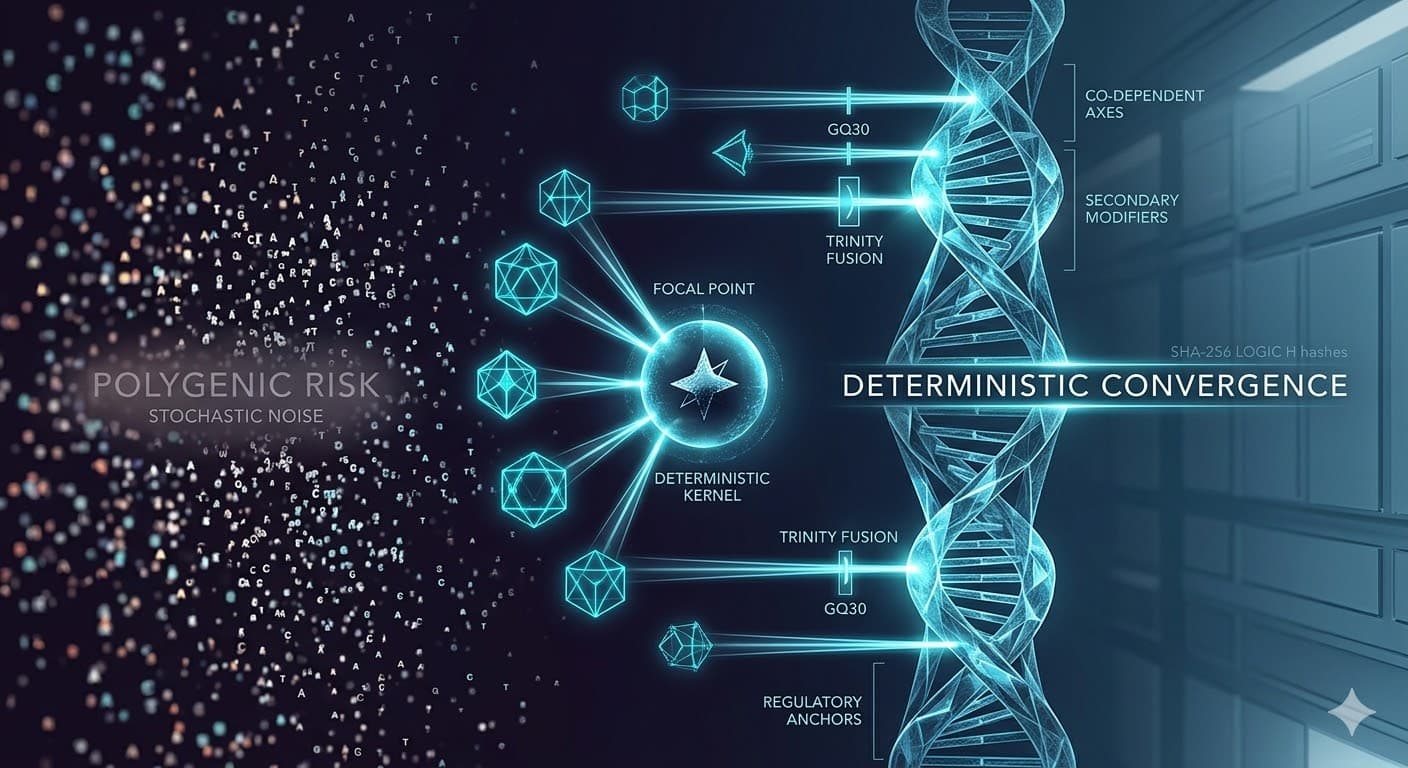
Deterministic Convergence refers to the reproducible emergence of stable genetic configurations in complex biological systems under identical conditions, even when key contributing variants are removed or perturbed. Rather than collapsing, these systems reorganize—preserving function and converging toward alternative, high-fitness states through distributed interactions among multiple variants. This behavior suggests that genomic causality is not concentrated in single genes, but instead arises from system-level constraint resolution, where multiple equivalent solutions can produce the same phenotype.

April 5, 2026Read
PROTEUS V3: How Deterministic Convergence Is Changing Drug Discovery | NomosLogic
PharmaceuticalsDrugDiscoveryGenomics

PROTEUS V3: How Deterministic Convergence Is Changing Drug Discovery | NomosLogic

Late-stage clinical trial failure isn’t a cost problem. It’s a systems problem. Drug development today relies on probabilistic models that fail to capture how biological systems stabilize under intervention. PROTEUS V3 changes that.

March 26, 2026Read
Beyond Polygenic Risk: Deterministic Convergence Reveals Hierarchical Organization in Genetic Systems
Deterministic convergenceGenetic architectureGenetic interaction

Beyond Polygenic Risk: Deterministic Convergence Reveals Hierarchical Organization in Genetic Systems

Additive models and polygenic risk frameworks have become standard approaches in human genetics, aggregating variant effects into composite estimates of phenotype. While effective in certain contexts, these models do not fully capture the structured, interactive nature of biological systems.

March 25, 2026Read
What is Deterministic Convergence in Genomics?
deterministic convergencedeterministic convergence genomicsgenomics

What is Deterministic Convergence in Genomics?

A concise definition of deterministic convergence in genomics: how biological systems reorganize and converge to stable states even after key genetic variants are removed.

March 25, 2026Read
Genomics May Be More Distributed Than We Ever Assumed
Deterministic convergenceGenetic architectureGenetic interaction

Genomics May Be More Distributed Than We Ever Assumed

For decades, genetics has largely been framed around a simple idea: find the important gene, understand the trait. That model has been productive—but incomplete. What we are now seeing suggests something deeper.

March 25, 2026Read
Why Genetic Systems Don’t Collapse: Rethinking Causality in Complex Traits
deterministic convergencedeterministic convergence biologydeterministic convergence genomics

Why Genetic Systems Don’t Collapse: Rethinking Causality in Complex Traits

For decades, the dominant paradigm in genomics has been implicitly simple: identify the variants most strongly associated with a trait, and you are closer to identifying its cause. But this assumption carries a hidden expectation — that biological systems are, at some level, reducible. That removing the most influential component should degrade or collapse the system’s behavior. What if that assumption is wrong?

March 25, 2026Read
From Additive Models to Structured Systems: Rethinking Genetic Architecture
Deterministic convergenceGenetic architectureGenetic interaction

From Additive Models to Structured Systems: Rethinking Genetic Architecture

Genetic variants contribute independently to phenotype, and their effects can be summed.

March 24, 2026Read
From Data to Decision to Prediction
genomicscontextdeterministic

From Data to Decision to Prediction

Most systems in healthcare operate in fragments. Genomics platforms resolve variants Clinical systems track patient data AI models attempt to predict outcomes But these layers are rarely unified. At NomosLogic, we’ve structured the system differently:

March 23, 2026Read
Getting Clinical AI Right: Why We Submitted Comments to the FDA
genomicsregulationdeterministic

Getting Clinical AI Right: Why We Submitted Comments to the FDA

There’s a growing conversation happening around AI in healthcare—how it should be used, how it should be regulated, and what standards it should be held to. This week, we submitted a comment to the FDA as part of that process. Not because we have all the answers. But because we’re building in this space—and we believe it’s important to help shape what “safe and effective” actually means in practice.

March 23, 2026Read
Press: Featured in GenomeWeb

Press: Featured in GenomeWeb

We were featured in GenomeWeb this week. Not for a model. Not for a demo. For a system. NomosLogic Dendrite Lite and our Clinical Standalone engine were highlighted as part of the next wave of genomic tools entering real-world use.

March 23, 2026Read
NomosLogic Clinical Decision Support: How to Use This With Your Doctor
Clinical Decision SupportUnderstandingHow to talk to your doctor

NomosLogic Clinical Decision Support: How to Use This With Your Doctor

NomosLogic is designed to help patients and physicians better understand complex biological information. It is a clinical decision support (CDS) system—not a diagnostic tool, and not a replacement for medical care.

March 23, 2026Read
NomosLogic Manifesto

NomosLogic Manifesto

We are not building another biotech company. We are building the infrastructure layer medicine has been missing.

March 21, 2026Read
The Gap Between Technical Debt and Technical Dishonesty
tech debtarchitecturesystem design

The Gap Between Technical Debt and Technical Dishonesty

When I think about genuine technical debt, there's always a moment of clarity in the origin story. Someone, usually under time pressure, usually with imperfect information, made a conscious tradeoff. They knew what they were deferring. They could articulate what it would cost to fix it later. The decision was made with eyes open.

March 21, 2026Read
The Applause Line Problem: Why Your AI Investment Isn't Working
AIGovernenceSignaling

The Applause Line Problem: Why Your AI Investment Isn't Working

A model trained on incomplete data produces confident answers from incomplete information. An AI layer built on top of a fragmented workflow automates the fragmentation. A tool deployed without changing the decision rights around it produces recommendations that no one is accountable for acting on.

March 21, 2026Read
From Variant Noise to Biological Structure: A Systems Approach to Genomics

From Variant Noise to Biological Structure: A Systems Approach to Genomics

Most genomic systems summarize risk by adding up variant effects. A different approach is to model biology as structured, constrained, and hierarchical. Across multiple domains, Proteus V3 suggests that genetic systems may organize into dominant axes or small co-dependent clusters rather than diffuse clouds of additive risk.

March 20, 2026Read
Beyond Polygenic Risk: Evidence for Hierarchical Organization in Genetic Systems

Beyond Polygenic Risk: Evidence for Hierarchical Organization in Genetic Systems

Additive models have become standard in human genetics, but they do not capture how biological systems are organized. Across multiple domains, Proteus V3 suggests that phenotype may emerge from stable genetic hierarchies, with some systems reducible to dominant axes and others dependent on co-equal network integrity.

March 20, 2026Read
The Adaptation Paradox How Evolutions’s Gifts Became Medicine’s Problems
genomicsadaptive evolutionparadox

The Adaptation Paradox How Evolutions’s Gifts Became Medicine’s Problems

Preview: The Adaptation Paradox How Evolutions’s Gifts Became Medicine’s Problems By Matthew Hardy A Revolutionary Framework for Understanding Genetics, Health, and Human Adaptation

March 20, 2026Read
Proteus V3: Cross-Domain Identification of Genomic Interaction Hierarchies and System Reducibility

Proteus V3: Cross-Domain Identification of Genomic Interaction Hierarchies and System Reducibility

Proteus V3: Cross-Domain Identification of Genomic Interaction Hierarchies and System Reducibility

March 20, 2026Read
National Press Release - NomosLogic Inc Launches Dendrite Lite and Defines a New Category:  Deterministic Clinical Genomics
ConsumerGenomicsDNA23andMe

National Press Release - NomosLogic Inc Launches Dendrite Lite and Defines a New Category: Deterministic Clinical Genomics

NomosLogic Inc Launches Dendrite Lite and Defines a New Category: Deterministic Clinical Genomics

March 15, 2026Read
Utah Press Release - Utah Founder Launches Platform That Reads Your DNA
HealthfamilyUtah community

Utah Press Release - Utah Founder Launches Platform That Reads Your DNA

Utah Founder Launches Platform That Reads Your DNA the Way Medicine Always Should Have

March 15, 2026Read
Why "Normal" is Not "Optimal": Genomic Contextualization
genomicsmulti-omicfusion

Why "Normal" is Not "Optimal": Genomic Contextualization

If you’ve ever been told your blood work is "fine" while you still feel sub-optimal, you’ve experienced the failure of population-average reference ranges.

March 13, 2026Read
From PDFs to Multi‑Omics
genomicsprecision-medicinebiotech

From PDFs to Multi‑Omics

Most clinical data lives in the wrong shape: unsearchable PDFs, faxed consult notes, proprietary lab portals, and genetic reports...

March 13, 2026Read
The 362 Drug Labels Nobody Checks
GenomicsConsumerGenomicsDNA

The 362 Drug Labels Nobody Checks

Three hundred and sixty-two. That is the number of FDA drug labels that currently require or recommend pharmacogenomic testing...

March 13, 2026Read
The Death of Approximation
architecturesoftwaredeterministic

The Death of Approximation

Kernel-level code doesn't negotiate. There's no graceful degradation at the OS level

March 13, 2026Read
I Asked My Own AI What My DNA Means. Here's What It Found.
genomicsdnapharmacogenomics

I Asked My Own AI What My DNA Means. Here's What It Found.

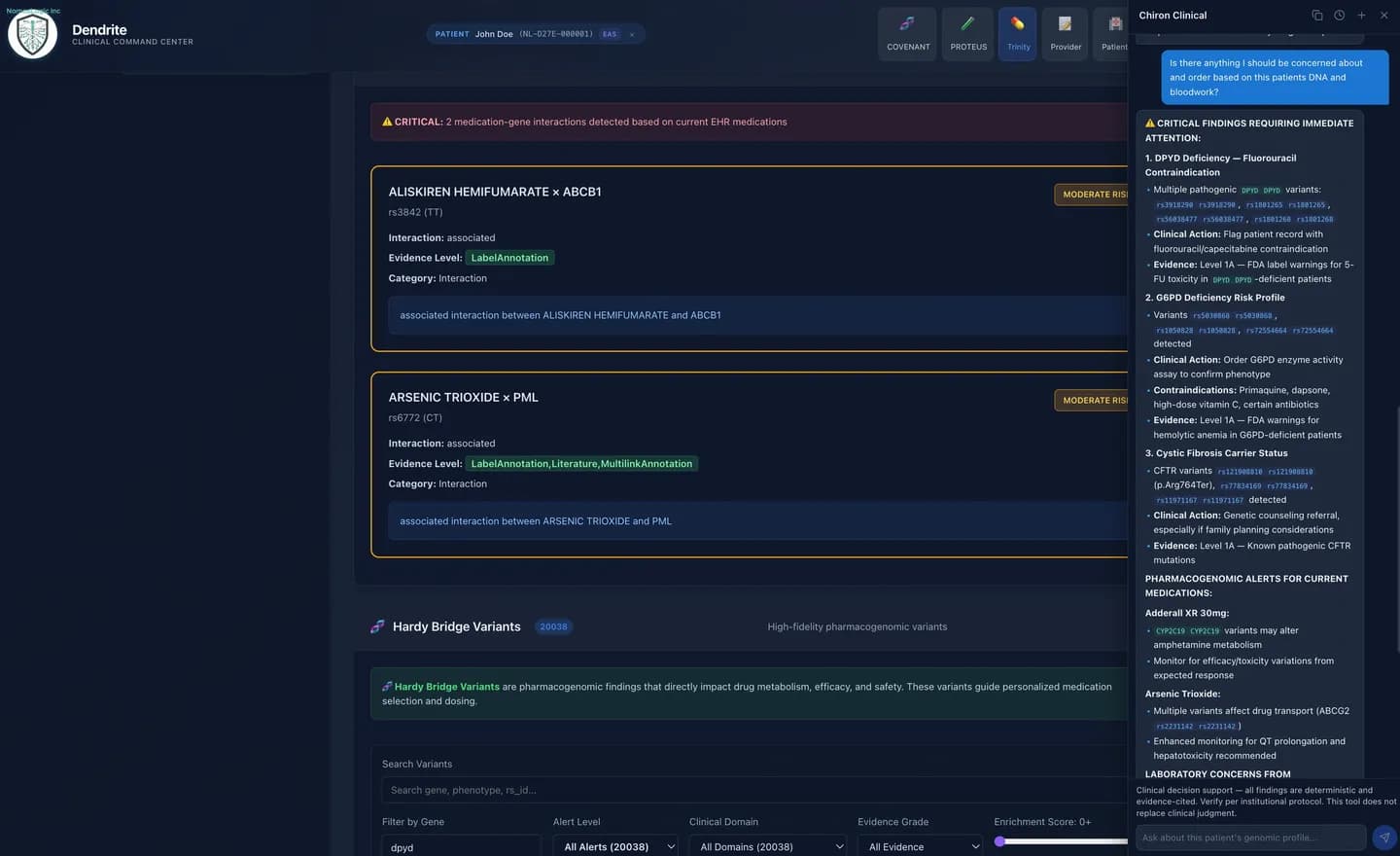
I've spent years building clinical genomic infrastructure. I know what the engine does. I know what the data says. I've read the literature, filed the patents, and written the code.Last week I sat down and had a real conversation with Chiron

March 13, 2026Read