
Hardy: The Founder as Systems Engineer
A founder profile on systems thinking, deterministic clinical infrastructure, and why medicine needs more than models.
Commentary
Most founders in health tech sell possibility. Hardy sells determinism.
This is not a study paper. It is a founder commentary on a builder who treats healthcare like a distributed system: reasoned, deterministic, and intolerant of hand-waving. The center of gravity is not charisma or slogan-making, but the discipline of building infrastructure that works under load and under scrutiny.
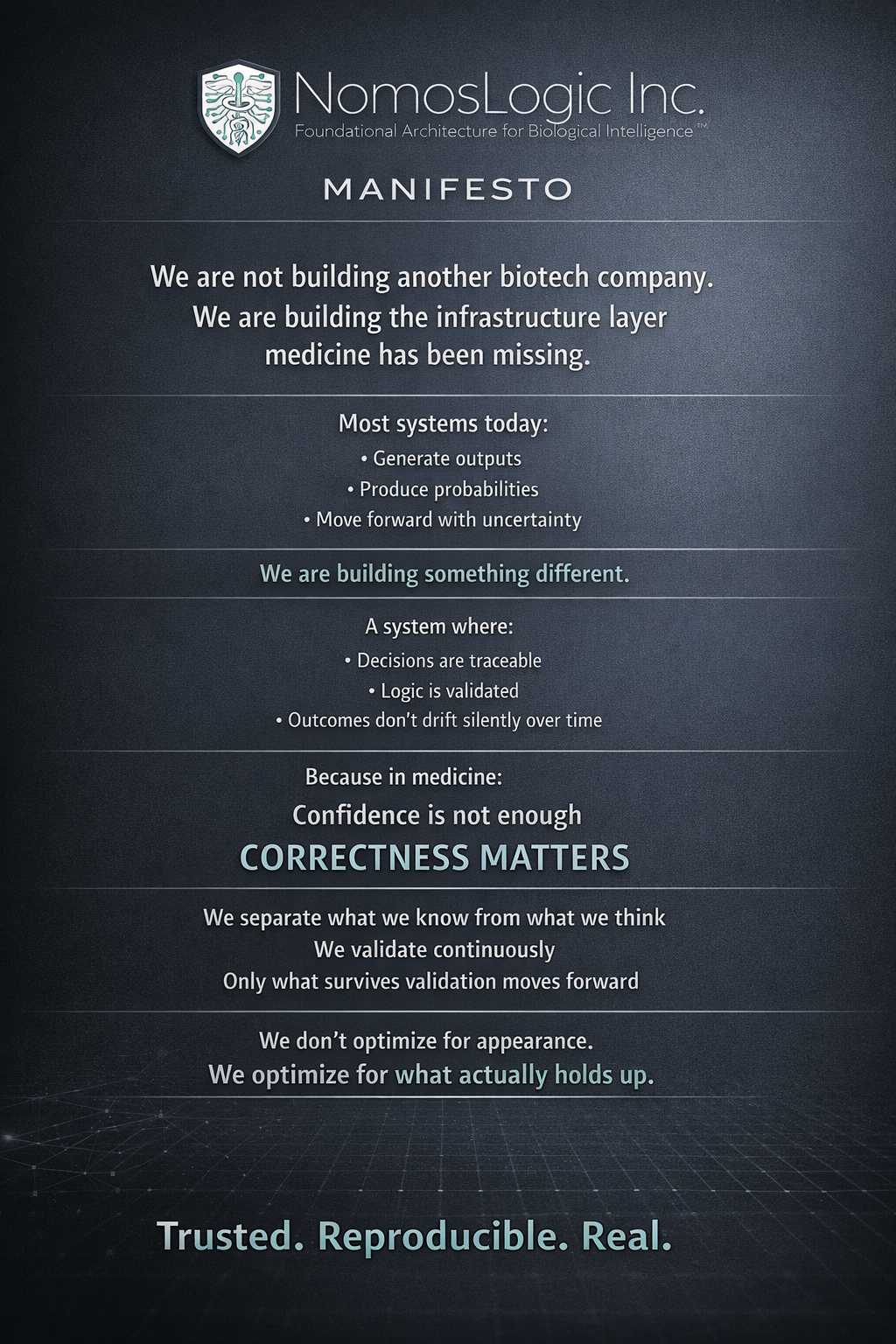
Most founders in health tech sell possibility. Hardy sells determinism. Where others celebrate models, he asks whether the thing still converges when you kick it. Where others promise future breakthroughs, he wants latency in seconds, logic that can be replayed, and an audit trail that survives scrutiny. His bet is simple: medicine will not move beyond the average until it is rebuilt on infrastructure that is hard enough to survive perturbation and clear enough to explain itself.
How Hardy thinks
Hardy’s operating lens is systems first. He treats genomes, workflows, and markets as coupled systems with failure modes, invariants, and load characteristics. DNA is not a bag of isolated markers. It is an architecture whose meaning depends on interaction and context. Clinical software is not a stack of features. It is a pipeline that has to deliver the same answer today and tomorrow, without drift.
That is why determinism sits at the center of his thinking. If the same inputs do not yield the same governed outputs, he does not consider it clinical infrastructure. Deterministic engines earn trust by being auditable, reproducible, and predictable in the most reassuring sense of the word.
He also treats perturbation as proof. Stable conclusions should survive pressure. If you remove an apparent anchor and the whole argument evaporates, the system was probably leaning on coincidence. If structure reorganizes and reconverges, you may be looking at something real.
How Hardy builds
Hardy’s build style is fast without looseness. He optimizes for cycle time, but not at the expense of provenance or replayability. Performance claims are expected to come with an audit path. A feature is not finished because it demos well. It is finished when it can be trusted.
He thinks in terms of orchestration, not heroics. Systems should scale because the architecture is coherent, not because the team keeps absorbing complexity by hand. That bias drives a preference for owning critical seams where interpretive variance, evidence normalization, or provenance become too important to outsource casually.
The end product, in his view, is not just a report. It is a clinical cockpit: fast, legible, and grounded in source-traceable logic. The point is to reduce cognitive burden without hiding mechanism.
AI in its lane
Hardy is explicit about where AI belongs and where it does not. AI can help at the experience layer. It can translate, summarize, and make complex outputs easier for clinicians and patients to navigate. But he draws a hard line between the interface and the clinical core.
In his model, AI speaks. Deterministic engines decide. The interface can make the result more human. It does not originate the clinical conclusion.
How Hardy fights
Hardy treats the external world as an adversarial environment. Regulation, incumbents, and distribution are not background noise. They are part of the system. Determinism is therefore not just an engineering virtue. It is also a regulatory argument and a market argument.
He thinks about intellectual property less as a trophy case and more as terrain. The point of patents is not ornament. The point is to shape the lanes others can drive in while infrastructure and standards mature.
He also sees distribution pragmatically. Consumer genomics platforms, payers, and health systems are not audiences. They are pipes where interpretation already needs to live. The goal is not to replace everything around them. The goal is to become the layer that makes existing assets usable.
Where this breaks
Founders who build like this earn their risks. The same sharpness that produces speed and clarity can create organizational concentration risk if standards, test coverage, and handoff discipline do not scale with the system. The mitigation is not mythology. It is codified standards, test suites, explicit handoffs, and institutional memory.
Determinism also does not remove the burden of proof. It clarifies the logic, but it still requires disciplined validation, edge-case handling, update control, and evidence governance as knowledge evolves.
And clinical adoption remains slow infrastructure work. Even when answers are faster and clearer, incentives, workflows, liability, and trust often move on a different clock.
Why it matters
The promise here is not a shinier report. It is a step away from the medical average. If interpretation becomes fast, deterministic, and legible, patients move closer to individual agency, clinicians recover time, and organizations can stop hiding uncertainty behind style and start exposing it with structure.
This is also a trust story. A glass-box engine paired with an honest interface creates a more durable social contract: you can ask why, and the system can show you. Every time.
Hardy is not trying to be the loudest founder in the room. He is trying to be the one whose system does not surprise you in the wrong way. His play is to make precision medicine feel like reliable infrastructure: fast, explainable, and anchored to decisions you can interrogate.