
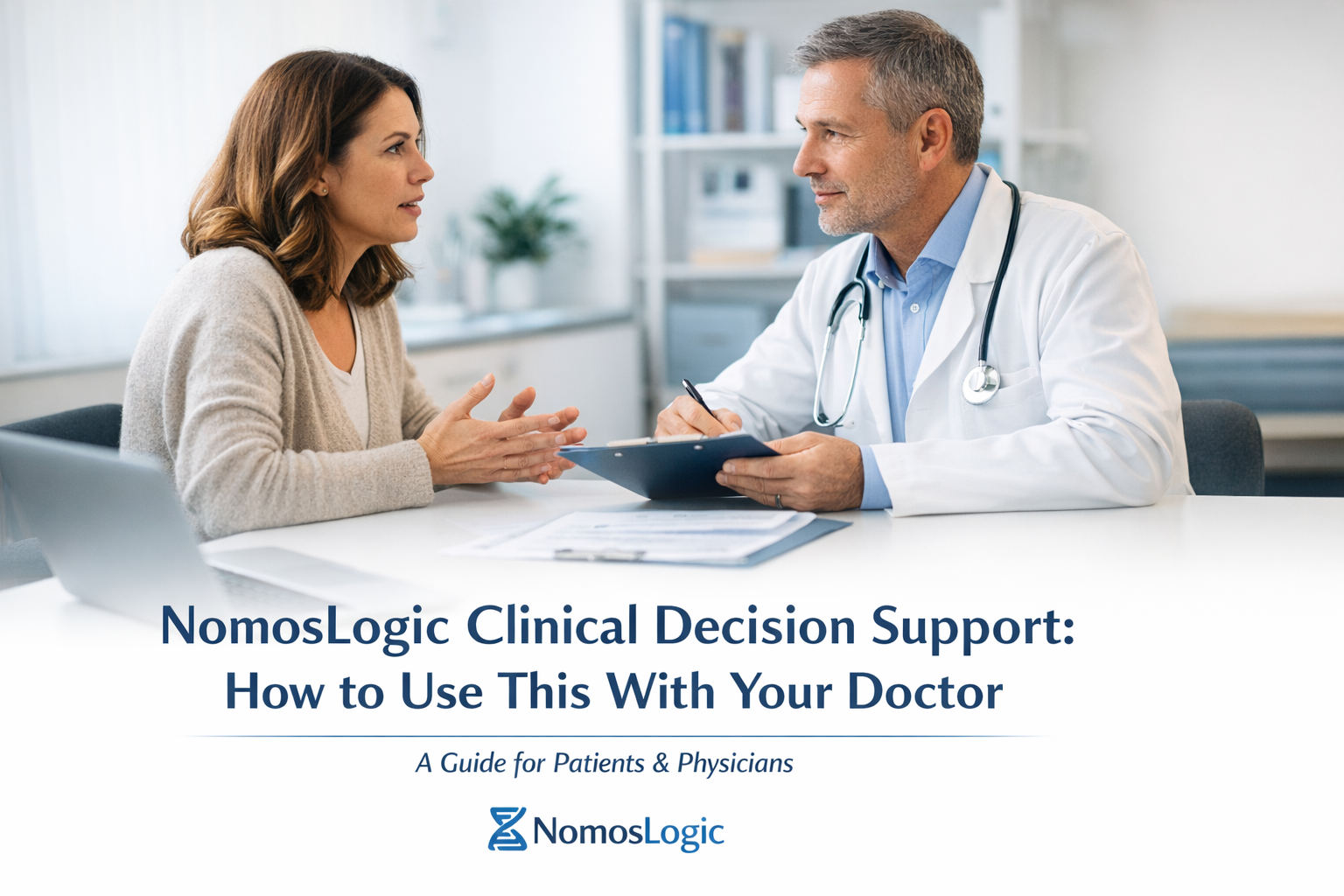
Understanding What This System Is—and What It Isn’t
NomosLogic is designed to help patients and physicians better understand complex biological information.
It is a clinical decision support (CDS) system—not a diagnostic tool, and not a replacement for medical care.
Its role is simple:
To surface relevant biological insights that can support more informed conversations between patients and their physicians.
Why This Matters
Modern medicine often involves:
complex data (genetics, labs, medications)
variable responses to treatment
symptoms that don’t always fit clean patterns
NomosLogic helps organize and interpret that complexity so it can be discussed more effectively in a clinical setting.
What NomosLogic Does
NomosLogic analyzes available data to:
Identify biologically relevant patterns and relationships
Highlight potential contributors to symptoms or treatment response
Surface medication and pathway considerations
Provide traceable logic behind each insight
Importantly, the system distinguishes between:
What is known (well-supported evidence)
What is inferred (supported but not definitive)
What remains uncertain
This separation is intentional—and critical for safe use.
What NomosLogic Does NOT Do
NomosLogic:
Does not diagnose medical conditions
Does not prescribe medications
Does not replace your physician
Does not make autonomous clinical decisions
All outputs are intended to be reviewed and interpreted by a licensed healthcare provider.
How to Use This With Your Doctor
If you choose to share your results, a simple way to frame it is:
“This is a clinical decision support tool that organizes biological information and highlights possible considerations. I’d like to review it with you to see what’s relevant.”
You can ask questions like:
“Do any of these findings align with what you’re seeing clinically?”
“Are any of these worth considering in my treatment plan?”
“Is there anything here you would disregard—and why?”
This keeps the conversation collaborative and grounded.
Clinical Alignment
NomosLogic is designed to support—not override—standard clinical care.
It aligns with:
Evidence-based medical practices
Known pharmacogenomic relationships
Established clinical reasoning workflows
The goal is not to introduce noise, but to add structured context where appropriate.
Safety and Validation Approach
NomosLogic is built around a core principle:
Clarity over confidence
The system is designed to:
Avoid overstatement or unsupported conclusions
Clearly indicate uncertainty where it exists
Prioritize patient safety and interpretability
Support physician-led decision-making
When evidence is limited, the system defaults to conservative interpretation.
A Collaborative Model
The best outcomes happen when:
Patients are informed and engaged
Physicians apply clinical expertise
Tools like NomosLogic provide structured support
This is not about replacing medicine.
It’s about improving how information is understood and applied.
Summary
NomosLogic is a clinical decision support system that:
Helps organize complex biological data
Surfaces relevant insights for discussion
Maintains clear boundaries around what is known vs uncertain
Supports—never replaces—physician judgment
Final Note
If your physician has questions or would like to better understand how the system works, we welcome that conversation.
Transparency and clinical collaboration are foundational to how NomosLogic is built.
Watch On YouTube:
https://youtu.be/p0GJF-uZ5FI?si=c_8U-mtqj2rePFrJ