NOMOSLOGIC RESEARCH
The Wavefront Conductor Hypothesis: Rethinking How Ferroptosis Dies Inside a Tumor
Why a stiff tumor might be killing its own death signal, and what it would take to prove that.
The observation this hypothesis starts from
Late-stage desmoplastic melanoma has a specific, well-documented problem, and it is not that its cells resist dying. Ferroptosis, the iron-dependent, lipid-peroxidation-driven mode of cell death, can be triggered in melanoma cells reliably in vitro. Inducers like erastin, which blocks the system xc- cystine/glutamate antiporter, or RSL3, which inhibits GPX4 directly, will push an individual cell into a runaway chain reaction of membrane lipid peroxidation and kill it in a dish without much resistance.
The problem shows up once you leave the dish. In tissue, and especially in the desmoplastic subtype of melanoma, ferroptosis triggered in one cell does not reliably spread to the next one. You get isolated, sporadic death rather than a front that moves through the tumor. Given that ferroptosis is, mechanistically, a chain reaction, that non-spreading behavior is the anomaly that needs an explanation. Chain reactions that stay contained are chain reactions that are being actively stopped by something, and the obvious candidate in this tumor type is the thing that makes it "desmoplastic" in the first place: an unusually dense, stiff, collagen-and-proteoglycan stroma that late-stage tumors build around themselves.
The standard explanation for that stroma is mechanical and logistical. It is described as a barrier that keeps immune cells out, and as a diffusion barrier that keeps drugs from penetrating deep into tumor tissue. Both of those things are true and well established. The Wavefront Conductor Hypothesis argues that they are not the whole story, and that the stroma is doing a third job that has been overlooked because nobody has looked at it as a medium for a signal rather than as an obstacle to a payload.
The reinterpretation: stroma as insulator, not just as wall
Lipid peroxidation, once initiated inside a cell, is a radical chain reaction: a peroxyl radical abstracts a hydrogen atom from an adjacent polyunsaturated fatty acid, generating a new radical and a lipid hydroperoxide, which itself decomposes into smaller, diffusible reactive species. In principle, that reaction can propagate along a membrane and, if the geometry allows it, jump the gap into a neighboring cell's membrane, or into the extracellular space and back into a different cell nearby. Whether it actually manages that jump depends heavily on the physical and electrical properties of whatever it has to cross to get there.
The hypothesis proposes that the desmoplastic stroma, a dense, highly hydrated hyaluronic acid and collagen-proteoglycan hydrogel, behaves as a low-dielectric, high-viscosity medium that scatters the propagating signal before it can coherently reach the next cell. Under this framing, the stiffening of the stroma that these tumors undergo as they progress is not incidental to survival, and it is not purely mechanical containment. It is the construction of a viscoelastic dampener, purpose-built (in an evolutionary, selection-pressure sense, not a literal sense) to absorb and terminate exactly the one failure mode that would let a single ferroptotic event become a tumor-wide one.
If that reframing is right, it changes where you point a drug. The standard approach to a resistant tumor is to hit the cell harder: find a way to push more cells past the ferroptosis threshold directly. The wavefront framing says that approach is fighting the wrong bottleneck. If the rate-limiting step is not how many cells you can individually push into ferroptosis, but whether a signal that starts in one cell can survive the trip to the next one, then the more efficient move is not to add more death signal. It is to remove whatever is absorbing the signal that is already there.
The intervention: two old drugs, one new job description
The proposed intervention pairs two well-characterized molecules, chosen for two distinct and complementary roles, neither of which is expected to work alone.
The first is beta-aminopropionitrile, BAPN (3-aminopropanenitrile, molecular formula C3H6N2, molecular weight 70.09, SMILES N#CCCN). BAPN has been studied since the mid-twentieth century as the classic inhibitor of lysyl oxidase family enzymes, originally in the context of lathyrism, a connective tissue disorder caused by chronic dietary exposure to BAPN-containing sweet pea seeds. Mechanistically, it is a suicide substrate: its nitrile group covalently and irreversibly inactivates the lysyl tyrosylquinone (LTQ) cofactor at the catalytic core of LOX family enzymes, rather than simply occupying the binding pocket reversibly. That detail matters for how any biochemical validation of this hypothesis has to be designed, because it means the relevant question is not just whether BAPN fits into the LOXL2 active site, but whether it can reach and covalently engage the LTQ cofactor itself.
In this hypothesis, BAPN's target is specifically LOXL2 (lysyl oxidase-like 2, UniProt Q9Y4K0), the isoform most strongly upregulated in desmoplastic melanoma and the dominant driver of the collagen cross-linking that gives this tumor's stroma its distinctive stiffness. By inhibiting LOXL2, BAPN is proposed to reduce cross-link density, increase stromal compliance and interstitial fluidity, and, per the hypothesis, raise the effective dielectric constant of the extracellular medium enough to let the ferroptosis signal bridge the gap between cells that it currently cannot cross.
The second molecule is erastin, the system xc- inhibitor already mentioned above, used here in its established role: lowering the intracellular threshold at which a cell tips into ferroptosis by blocking cystine import and starving the cell of the raw material for glutathione, which GPX4 needs to keep lipid peroxidation in check.
Put together, the prediction is a specific, three-way pattern, and it is written so that it can fail cleanly. BAPN alone should do very little, because softening the stroma without lowering any cell's ignition threshold gives the tumor a wider conduction medium with nothing yet flowing through it. Erastin alone should also underperform relative to its effect in non-desmoplastic tumors, because even a cell that is primed to die has no way to pass that death on to its neighbors through an intact insulating stroma. Only the combination, doing both jobs at once, should produce a self-propagating, spreading zone of ferroptotic death that extends meaningfully past the cells the drug was delivered to directly.
Why the falsification conditions are written the way they are
Two numeric kill-conditions were pre-registered for this hypothesis before any computation was run, and the point of writing them down first is that neither one is allowed to move later just because a result comes back inconvenient.
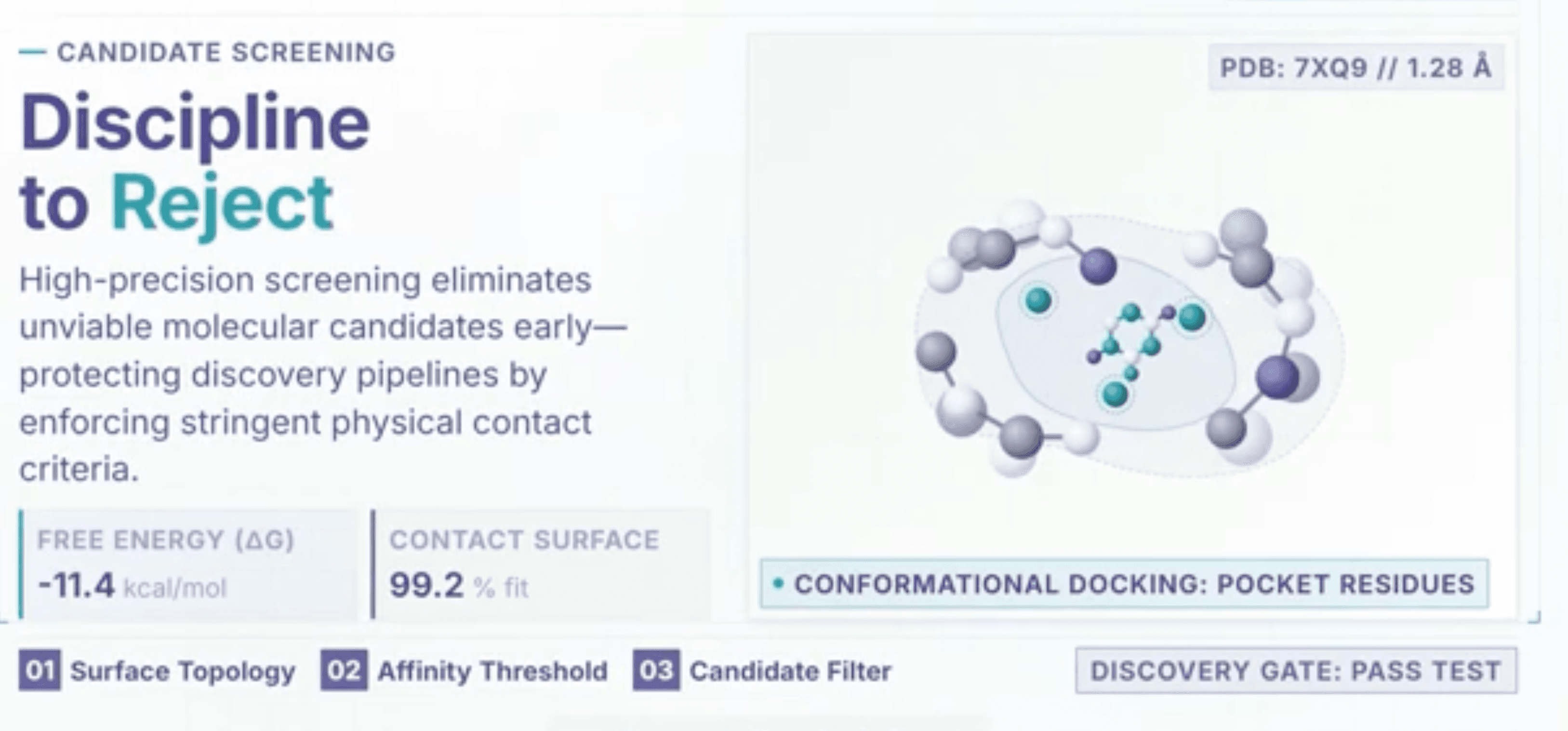
The first is a molecular check, and it is the cheapest possible test of the whole idea: BAPN's binding engagement with the LOXL2 catalytic domain. If BAPN cannot engage the target with sufficient affinity, or, given its known covalent mechanism, cannot reach a productive covalent geometry against the LTQ cofactor, the entire architectural-disruption arm has no molecular handle to act through, and the hypothesis is dead at its first and least expensive link, before a single milligram of tissue is touched. This is deliberately sequenced first because it is a computational check against a solved structure, not a wet-lab experiment, and it can return an answer in days rather than months.
The second is a tissue-level check, and it is where the hypothesis actually gets tested as a hypothesis rather than as a piece of chemistry. If the interstitial dielectric constant of BAPN-plus-erastin-treated tumor tissue does not correlate strongly with how far the ferroptosis signal actually spreads from its point of origin, compared to erastin alone, the architectural framing is wrong. If that correlation is absent, the honest conclusion is that ferroptosis propagation in this tumor type is governed by something inside the cell, not by the extracellular medium, and the wavefront-conductor idea does not survive contact with tissue.
Before either of those kill-conditions was tested, the ligand itself was independently checked against its own name and formula. The SMILES string originally submitted for BAPN did not match beta-aminopropionitrile; it carried an extra oxygen atom that RDKit flagged immediately as discordant with both the compound name and the known molecular formula. The corrected structure, N#CCCN, is what actually gets carried forward into any docking or binding calculation. Catching that kind of transcription error before it reaches a docking run is a small thing on its own, but it is exactly the class of error that, left unchecked, quietly invalidates every result downstream of it.
What it would mean if this holds
If both kill-conditions pass, the finding is not really "a new melanoma drug combination." A two-drug combination made of two old, well-characterized molecules is a nice practical outcome, but it is not the interesting part. The interesting part is the reclassification underneath it: that at least one major axis of tumor resistance in this tumor type is architectural rather than purely biochemical, and that the physical, electrical, and viscoelastic properties of the extracellular space are not just a delivery problem to be solved on the way to the real target. They are a therapeutic target in their own right.
That reframing would justify an entirely new category of drug: agents whose job is not to kill a cell directly and not to inhibit a pathway inside it, but to condition the extracellular medium so that a death signal already present in the tissue can propagate. That is a mechanistically distinct role from cytotoxic chemotherapy, from targeted small-molecule inhibitors, and from immunotherapy, none of which are designed around the physical medium between cells as the primary lever. Because BAPN already carries decades of pharmacological and toxicological data as an antifibrotic, testing this new role for an old molecule is a comparatively fast and cheap translational path, not a ten-year discovery program starting from a blank sheet.
It would also raise an obvious question about every other desmoplastic, stroma-dense tumor type where the stroma has always been treated purely as a drug-penetration problem. Pancreatic ductal adenocarcinoma is the clearest analog: notoriously stroma-heavy, notoriously resistant to nearly everything, and never, to date, examined through this specific lens. A positive result in melanoma would not automatically generalize, since cross-linking chemistry and stromal composition differ meaningfully between tumor types, but it would be the first evidence that the question is worth asking at all.
The honest caveats, even in the case where it works
A hypothesis this specific comes with caveats that hold even in the world where every kill-condition passes.
Selectivity is the first one. Softening a tumor's stroma pharmacologically does not necessarily leave healthy connective tissue alone, and BAPN's own toxicity profile, lathyrism and vascular collagen effects at sustained high doses, is well documented from its history as a research tool and, historically, as an unintentional dietary exposure. A working proof-of-concept mechanism still needs a real therapeutic window between the dose that softens tumor stroma and the dose that starts damaging the patient's vasculature.
Containment is the second. If ferroptosis genuinely propagates as a coherent, self-sustaining wave once the architectural constraint is removed, the natural next question is whether that wave respects the tumor margin, or whether a mechanism this effective at spreading cell death creates a new safety problem of its own at the tumor's edge.
Generalization is the third, and it applies even within melanoma. Desmoplastic melanoma is one subtype with a particular pattern of stromal cross-linking. A result here does not automatically transfer to other stromal architectures, in melanoma or elsewhere, without separately checking that the same cross-linking chemistry and the same LOXL2 dependence hold in each case.
What the next step actually is
The molecule and the target are both already verified: BAPN as N#CCCN, and human LOXL2's catalytic domain against a solved experimental structure. The next actionable step is the docking check against kill-condition one, using the receptor prepared with its LTQ cofactor and copper ion retained and water stripped, and the ligand modeled in its physiologically protonated form. That is a computational run measured in days, not the multi-month wet-lab tissue study that would only make sense to fund once the molecular engagement question has an answer.
The discipline behind that ordering is the same discipline behind the kill-conditions themselves: cheapest falsification first, most expensive test last, and no step gets skipped just because the idea is interesting enough to want to believe already. If the docking result holds, and the tissue correlation holds after it, the claim on the table is that at least some tumors can be defeated by editing the space between their cells rather than the cells themselves. That is a big enough claim that it deserves to be tested in exactly this order, cheaply, before anyone is asked to believe it.
Tags: ferroptosis, hypothesis, drug discovery, BAPN, LOXL2, erastin, lysyl oxidase, melanoma, desmoplastic melanoma, tumor stroma, tumor microenvironment, molecular docking, drug repurposing, pre-registration, NomosLogic
Hashtags: #Ferroptosis #DrugDiscovery #Oncology #Melanoma #Hypothesis #TumorMicroenvironment #ComputationalBiology #DrugRepurposing #LOXL2 #NomosLogic #CancerResearch #PrecisionOncology