
NomosLogic Insight Article
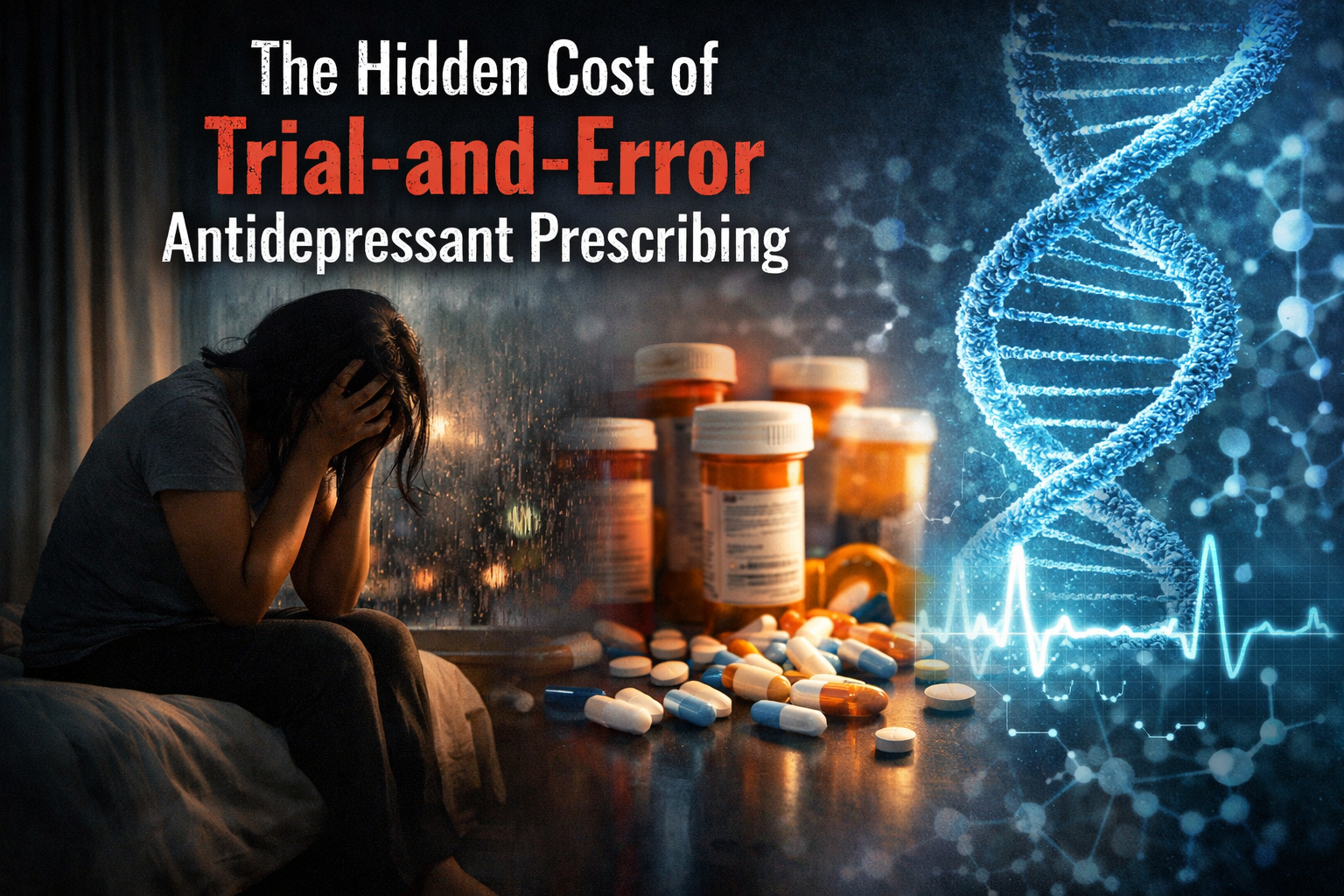
Two Years of Misery: What One Conversation Could Have Prevented
By Matthew L. Hardy, Founder & CEO, NomosLogic Inc.
I spent two years trying to find an antidepressant that worked.
Two years of three-month trials. Two years of medications that did not just fail to help, but made everything worse. Two years of a medical system that had no better strategy than, “let’s try this one next.”
Every SSRI I tried amplified the darkness instead of lifting it. The fog got thicker. The weight got heavier. And every time a medication failed, I had to taper off, wait, and start again with something new. The process itself became its own kind of suffering.
Eventually, through sheer endurance, I found Bupropion. It worked. Not perfectly, not magically, but it worked. It was the only one that ever did.
I did not know why at the time. I just knew I had finally reached the right answer after exhausting the wrong ones.
The biological signal was there
Years later, I built NomosLogic. I also built Chiron, the interpretive layer that helps make the deterministic outputs of our clinical genomics infrastructure understandable to human beings.
Recently, I asked Chiron a question.
I gave it my genetic data and asked it to reason through which antidepressant pathway my biology seemed to support. I did not tell it my history. I wanted to see whether the biological logic would lead toward the same answer that took me two years to discover by suffering through failure.
Its reasoning was transparent.
First, it looked at the common thread among the medications that failed. Because most first-line antidepressants act heavily through serotonin, it evaluated whether the serotonin pathway appeared biologically mismatched.
Then it looked for an alternative pathway with stronger biological support. It identified a dopamine and norepinephrine route as more plausible.
Chiron’s conclusion was not “this drug is guaranteed to work.” Its conclusion was that the biology pointed away from a serotonin-heavy strategy and toward a different mechanism. In practical terms, that led to one medication that fit that logic: Bupropion.
That was the same answer I had spent two years discovering the hard way.
What the conversation really revealed
The power of that moment was not that a system named a drug.
The power was that it made the pathway logic legible.
It explained why one class may have been a poor fit. It explained why an alternative mechanism made more sense. It turned years of trial-and-error into a biologically coherent story.
That matters because many patients do not experience medication failure as an abstract inconvenience. They experience it as worsening mood, destabilization, fear of the next taper, and another lost quarter of their life.
The real cost of mechanism-blind prescribing is not only inefficiency.
It is avoidable harm.
Why this matters to health plans
For health plans, a case like this is not just a personal story. It is a utilization story, a pharmacy story, and a risk story.
Every failed medication cycle can mean additional visits, additional prescriptions, more follow-up, more discontinuation management, and escalating behavioral health cost. If the patient deteriorates while the wrong mechanism is being tested, the plan absorbs not only the pharmacy waste, but the downstream clinical burden as well.
Internally, NomosLogic positions TRINITY as deterministic clinical genomic infrastructure that fuses existing DNA, bloodwork, and clinical data in roughly 75 seconds and writes structured results into enterprise workflows. It is infrastructure software, not a sequencing service and not a replacement for clinicians. It is designed to make existing biological data usable before harm compounds.
That framing matters.
The value proposition is not autonomous prescribing. It is earlier recognition of pathway mismatch, more traceable reasoning, and a stronger starting point in categories where trial-and-error prescribing still carries real risk. NomosLogic’s public clinical decision support framing is explicit that the platform helps interpret biological data, highlights medication and pathway considerations, and provides traceable logic, while not diagnosing, prescribing, replacing the doctor, or making autonomous decisions.
For plans, the practical question is straightforward: how many high-cost, high-risk medication journeys are really biology mismatches being discovered too late?
Why this matters to physicians
For physicians, the value is not a promise of certainty. The value is a more biologically grounded, more defensible place to start.
A clinician still has to make the decision. A patient still has to be monitored. Context still matters. But there is a world of difference between beginning with blind trial-and-error and beginning with interpretable biological logic that helps explain why one pathway may deserve priority over another.
That is especially important in depression care because the cost of being wrong is not confined to inconvenience. A patient can worsen while waiting to prove that a class is a poor fit. Coming off the wrong drug can carry its own burden. In the background, clinicians are also carrying the weight of preventable harm, documentation burden, and the reality that a missed biological clue may later look obvious in retrospect.
What I still carry
I no longer take antidepressants. I have learned to manage what I have.
The dark cloud still falls sometimes, even when everything is going right. That is the biological nature of it. Depression is not always a response to circumstances. Sometimes it is internal weather, a shift in chemistry that has nothing to do with what is happening in your life.
Knowing my genetics does not make that disappear. But it does help me understand that there is underlying biology to what I have lived. It gives shape to what once felt random.
Self-awareness taught me how to navigate the storm.
Biological insight helped me understand the storm itself.
Why I built this
NomosLogic exists because I lived the failure of the current system.
Two years of unnecessary suffering exposed by a single conversation that made the underlying pathway logic visible. The biological signal was there. What was missing was the bridge that could connect it to a decision before more harm accumulated.
That is what we are building.
Not another chatbot.
Not another static report that sits unread in a portal.
Infrastructure. Deterministic clinical genomic infrastructure that helps turn raw biological data into usable, traceable support at the point of care.
The goal is simple:
No one should have to spend two years guessing when their biology may already contain a better place to start.
The question
The question this leaves behind is not whether more data exists.
It does.
The question is whether that data becomes usable before harm compounds.
Because a system that cannot connect the answer to the question has already failed the patient.
The real cost of mechanism-blind prescribing is not only inefficiency. It is avoidable harm.
Important note: This article discusses the value of biologically grounded clinical decision support and patient-facing interpretation. It is not medical advice. Chiron does not diagnose, prescribe, or replace the treating clinician.
Prepared for public publication. Based on a real Chiron-patient conversation, edited for clarity and privacy, and aligned with current NomosLogic product positioning around deterministic clinical decision support and multi-omic fusion infrastructure.