
Intro
There’s a growing conversation happening around AI in healthcare—how it should be used, how it should be regulated, and what standards it should be held to.
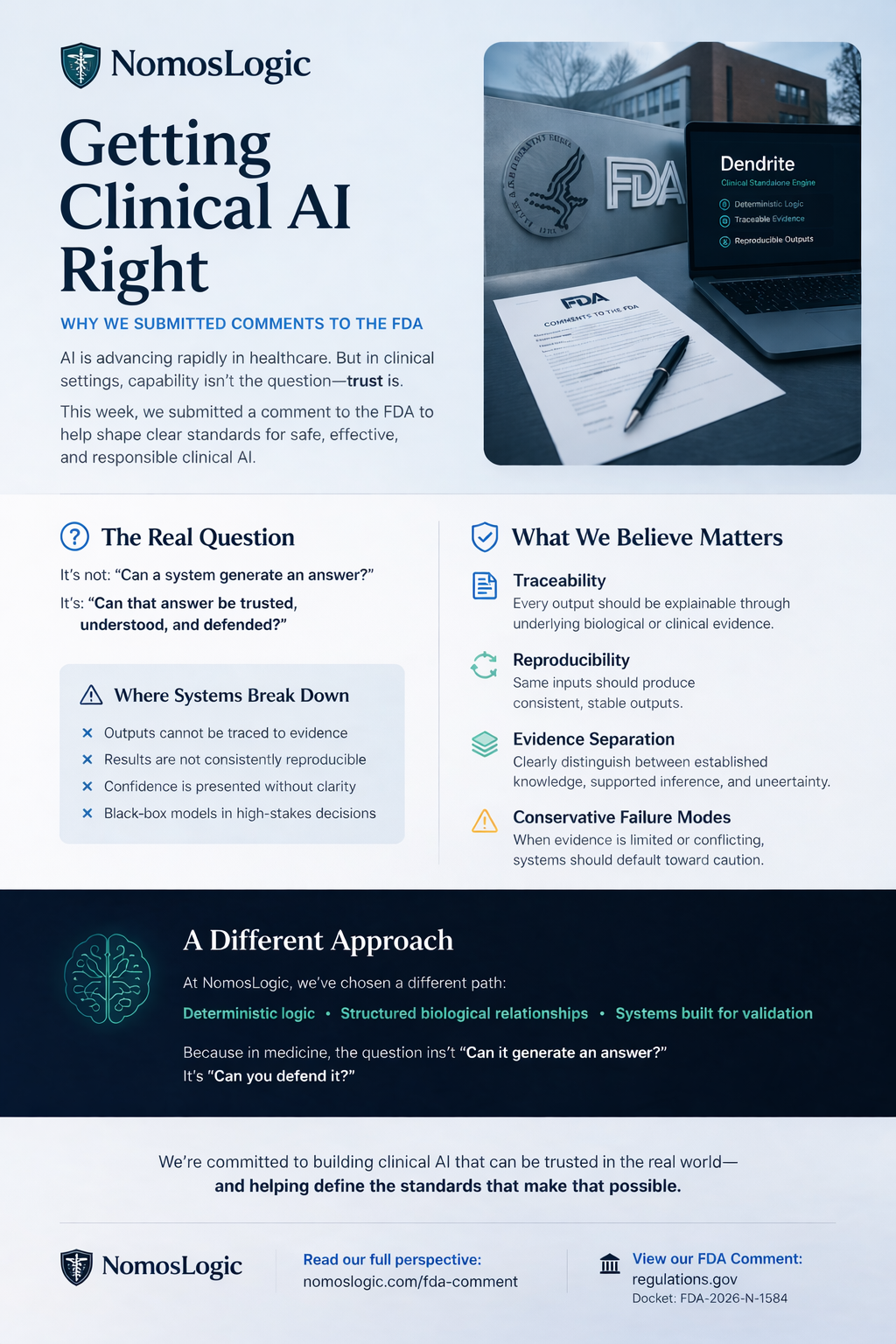
This week, we submitted a comment to the FDA as part of that process.
Not because we have all the answers.
But because we’re building in this space—and we believe it’s important to help shape what “safe and effective” actually means in practice.
The Current Conversation
A lot of the discussion around AI in healthcare today focuses on:
model performance
access to data
scalability
These are important.
But they are not the core problem.
In clinical settings, the question is not:
Can a system generate an answer?
It’s:
Can that answer be trusted, understood, and defended?
Where Systems Break Down
From an engineering perspective, many systems fail in predictable ways:
Outputs cannot be traced back to evidence
Results cannot be reproduced consistently
Confidence is presented without clarity
Models operate as black boxes in high-stakes environments
These issues are manageable in consumer applications.
They are not acceptable in clinical decision-making.
What We Believe Matters
In our FDA comment, we focused on a few principles that we believe are foundational:
1. Traceability
Every output that influences a clinical decision should be explainable in terms of underlying biological or clinical evidence.
2. Reproducibility
Given the same inputs, a system should produce consistent, stable outputs.
3. Evidence Separation
Systems must clearly distinguish between:
established knowledge
supported inference
and uncertainty
4. Conservative Failure Modes
When evidence is limited or conflicting, systems should default toward caution—not confidence.
Why This Matters Now
AI capability is advancing rapidly.
But clinical systems don’t fail because they lack capability.
They fail when:
outputs cannot be validated
decisions cannot be defended
or trust breaks down between patient and physician
If we don’t get the standards right now, we risk building systems that scale quickly—but fail when it matters most.
A Different Approach
At NomosLogic, we’ve taken a different path.
Instead of optimizing for probabilistic output generation, we’ve focused on:
deterministic logic
structured biological relationships
and systems that prioritize interpretability and validation
Not because it’s easier.
But because it aligns more closely with how clinical decisions are actually made.
The Role of Industry
Regulation should not be something that happens to companies.
It should be informed by the people building and using these systems.
That includes:
clinicians
researchers
engineers
and patients
Submitting a comment is a small part of that.
But it’s part of participating in a broader responsibility.
Closing
Healthcare doesn’t need more impressive demos.
It needs systems that can be trusted in real clinical environments.
That means:
clear standards
defensible outputs
and a shared understanding of what “safe” actually looks like
We’re committed to building toward that standard—and contributing where we can to help define it.
Read the full comment
Opportunity for Public Comment on Rare Disease Educational Materials from the Center for Drug Evaluation and Research’s Accelerating Rare disease Cures Program and the Rare Disease Innovation Hub