

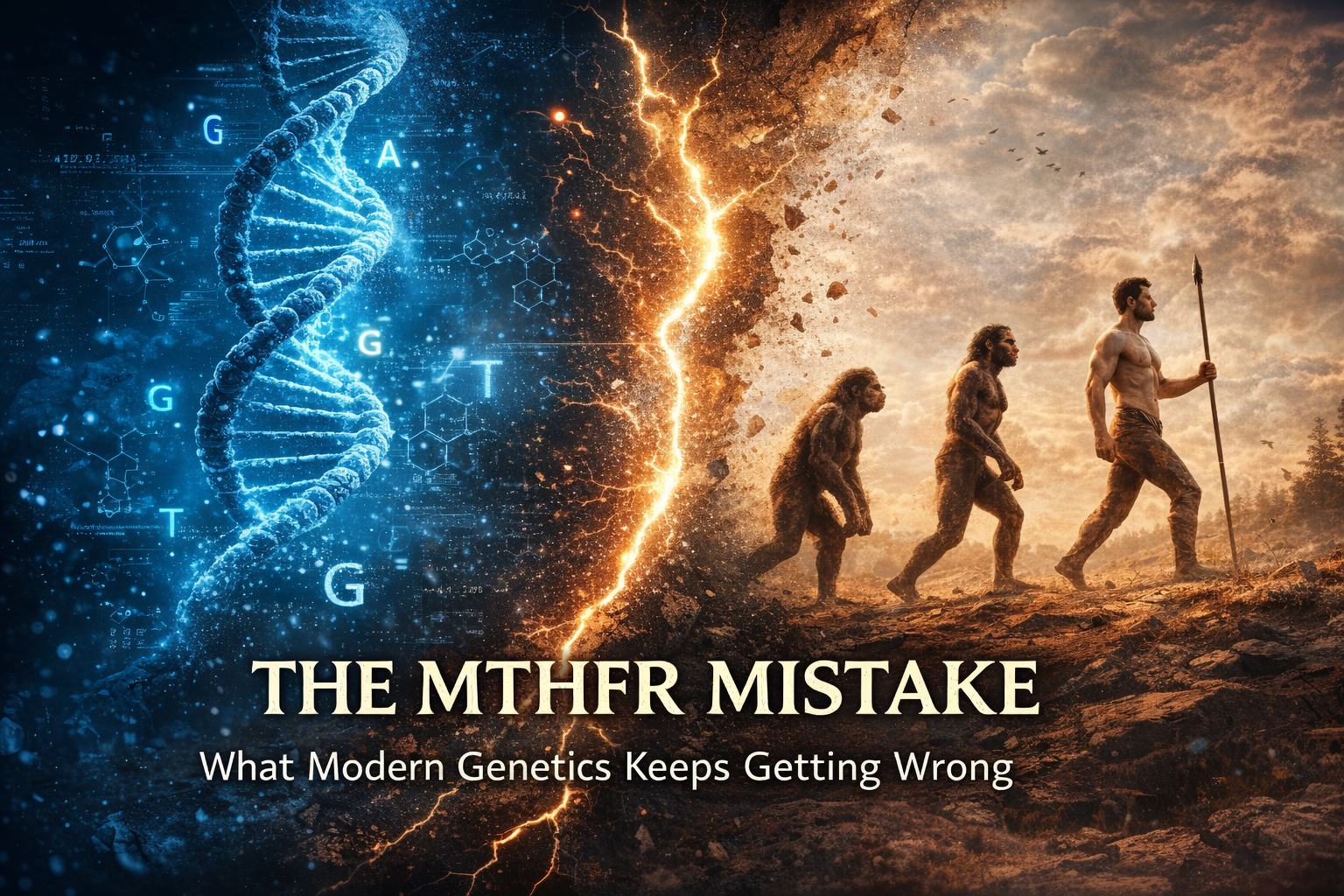
What a Common Variant Reveals About Evolutionary Adaptation and the Failure of Average-Based Genomics
By Matthew Hardy
Thesis
MTHFR is not important because it proves a simple story of defect. It is important because it exposes how modern genomics keeps mistaking common, context-dependent human variation for pathology.
Why MTHFR became famous
MTHFR became one of the most recognizable names in consumer genetics because it sits at the intersection of folate metabolism, pregnancy, cardiovascular risk, and internet medicine. The common C677T and A1298C variants became shorthand for a much larger cultural narrative: if you carry the wrong letter at the wrong position, your biology is somehow broken. That story spread because it is simple, commercially useful, and emotionally potent. It is also incomplete.
The problem is not that MTHFR does nothing. It does. The gene encodes methylenetetrahydrofolate reductase, an enzyme involved in folate metabolism and homocysteine handling. But the leap from modest biochemical effect to sweeping claims of systemic dysfunction is where interpretation begins to fail. Official public-health guidance is much narrower. Common MTHFR variants do not justify panic, and they do not support the idea that a person is genetically broken.
What the common variants actually mean
The common variants are common for a reason. That matters. A variant found across large segments of living populations should not be approached reflexively as if it were a rare catastrophic defect.
This is where average-based genomics starts to distort reality. A population-level association, especially when detached from ancestry, diet, reproductive context, folate status, and the rest of the genome, gets turned into a personal verdict. But MTHFR is not a moral category. It is a biological variable. The common variants may alter enzyme efficiency. They may matter more in some contexts than others. They may interact with nutrition, stress, pregnancy, or the broader genetic background. What they do not do is justify an automatic story of generalized pathology.
Clinical guidance has been more restrained than the popular mythology around the gene. For years, professional genetics guidance has warned against overstating the clinical utility of routine MTHFR polymorphism testing in settings where evidence is weak. That is an important distinction. Biology matters. Overinterpretation is the problem.
Why MTHFR belongs in an evolutionary conversation
This is where MTHFR becomes more than a genetics explainer. It becomes a window into evolutionary adaptation.
Human variation is not random debris. Much of it reflects long exposure to different nutritional environments, pathogen burdens, reproductive pressures, and ecological constraints. A common variant that persists across populations should immediately raise a different question than the one modern reductionist genetics usually asks. Not first, "What disease does this cause?" but, "Under what conditions might this have been tolerated, balanced, or even advantageous?"
That question does not require romanticizing every common variant as beneficial. Sometimes the answer is neutrality. Sometimes it is tradeoff. Sometimes it is a historical environment that no longer exists. But in every case, the right frame is conditional biology, not instant defect labeling.
This is the exact bridge back to The Adaptation Paradox. Medicine often interprets the present while forgetting the past. It sees a variant in a modern clinical environment and assumes the variant itself is the problem. But many of the traits we call risky today may be remnants of strategies that were useful, tolerable, or contextually adaptive in older environments. The failure is not only scientific. It is conceptual. We keep confusing environmental mismatch with biological defect.
What the public-health view gets right
The official public-health view is much less dramatic than the internet version of MTHFR. The central message is practical: folate status matters, folic acid matters, and genotype alone should not be used to scare people into thinking they cannot process folate or must reconstruct their biology around a single common variant.
That matters because MTHFR has become a case study in interpretive inflation. A subtle enzyme difference gets translated into the language of broken methylation, dangerous toxicity, or generalized physiologic failure. That may be useful for selling certainty, but it is not the same as careful molecular medicine.
None of this means context does not matter. Folate status matters. Pregnancy matters. Diet matters. Other variants matter. The rest of the system matters. That is exactly the point. MTHFR is a systems problem being repeatedly flattened into a single-variant morality tale.
The real lesson
The most important lesson of MTHFR is not a supplement recommendation. It is that genomics is still too often practiced as a shortcut to narrative instead of an infrastructure for truth.
A common variant with modest, context-dependent effect should force rigor. It should make us ask about ancestry, environment, reproductive context, nutrient exposure, and the difference between biochemical signal and clinical consequence. Instead, it often gets turned into a brand.
That is why MTHFR matters. Not because it proves a dramatic story, but because it reveals the weakness of the framework interpreting it. When medicine treats common human variation as pathology without sufficient context, it does more than make a technical error. It teaches patients to fear their inheritance instead of understand it.
The future of molecular medicine cannot be built on that kind of flattening. It has to be built on governed interpretation, population context, and a serious respect for evolutionary history. MTHFR is not just a variant. It is a warning about what happens when genomics forgets how human beings were made.
Sources consulted
- CDC: MTHFR Gene Variant and Folic Acid Facts
- CDC: Folic Acid Facts for Clinicians
- MedlinePlus Genetics: MTHFR gene
- ACMG Practice Guideline: lack of evidence for MTHFR polymorphism testing
This article is written for thought leadership and category framing. It is not personal medical advice, and individual clinical decisions should be made with a qualified physician or genetic counselor.